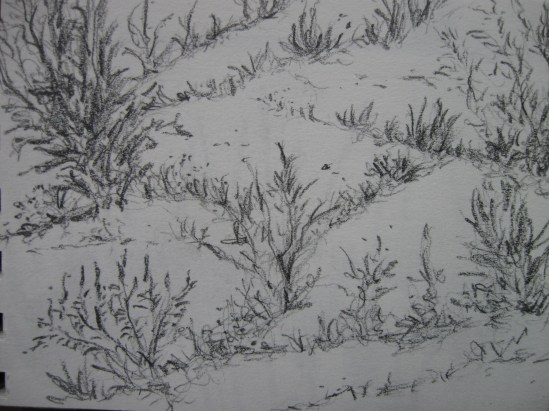
Cement Crack Weeds (pencil)

Tool Company (pencil)

Jetty (pencil)
Cement Crack Weeds (pencil)
Tool Company (pencil)
Jetty (pencil)

Crochet Hook (pen)

Still Life (pencil)


Ghost Town Harbor (conte pencil)

Walled Gardens (pencil)
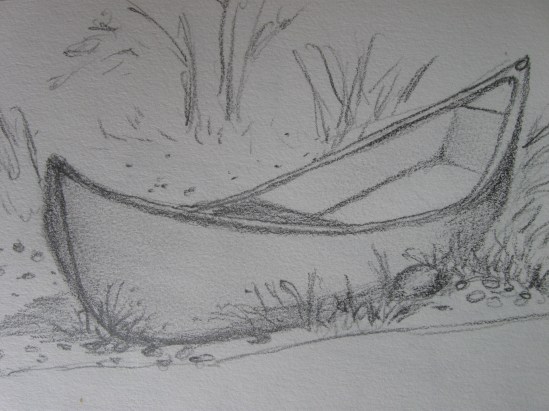
Granite Pier Skiff (pencil)
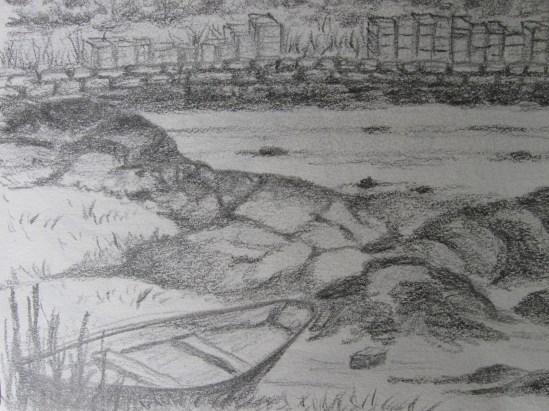
Lanes Cove (pencil)
Goodbye to the mansion. For my last two weeks there I had this view and the smell of lilacs from my office window.

Office View with Lilac (pencil)
And here’s my new desk.

Van Gogh said:
At times there is something indescribable in those aspects — all nature seems to speak; . . . As for me, I cannot understand why everybody does not see it and feel it; nature or God does it for everyone who has eyes and ears and a heart to understand. For this reason I think a painter is happy because he is in harmony with nature as soon as he can express a little of what he sees. And that’s a great thing — one knows what one has to do, there is an abundance of subjects, and as Carlyle rightly says, “Blessed is he who has found his work.”
(From Van Gogh: A Self-Portrait, W. H. Auden, ed., 1963)
Here’s a little painting from a place near my favorite marsh, a meadow verging on marsh, last fall.
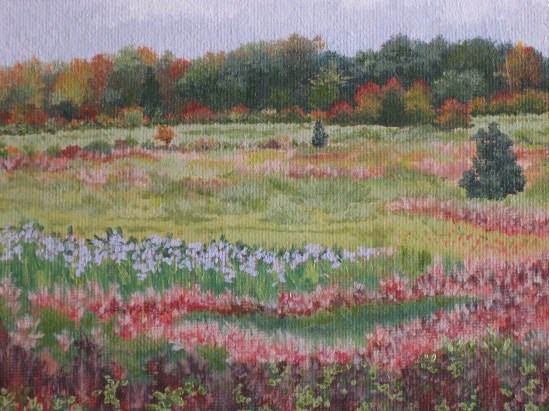
Essex Meadow, October (oil)
Van Gogh’s lesson for me today:
Rappard has painted some good studies, among others a few after the models at the academy, which are well done. A little more fire and passion would not hurt him, a little more self-confidence and more courage. Somebody once said to me, “We must make the same efforts as lost, desperate beings.” He does not do that as yet. His pen-and-ink drawings of landscape are very witty and charming, but in these, also, a little more passion, please.
(From Van Gogh: A Self-Portrait, W. H. Auden, ed.)
I’m focusing on drawing at all right now, and drawing accurately, and learning how to paint, but at the same time I hope I can keep those words in mind. I want to push past my carefulness and dutiful copying, and let some feeling and messiness come out if it wants to.
Here’s a charcoal drawing I really enjoyed doing because I love sumac so much, especially in the late fall when the leaves are gone and they’re very dramatic looking.

Sumac (charcoal pencil)
This tiny landscape is of one of my favorite places, a marsh in Essex, Mass., a couple of towns over. I stop at this spot on my way to work when I have time; it’s beautiful in every season.

Essex Marsh, July (oil on canvas)
This was my first attempt at freeform lace.

Freeform lace (seasilk)
I’m reading the letters of Vincent Van Gogh (Van Gogh: A Self-Portrait, edited by W. H. Auden, 1963) and he has so many beautiful and encouraging things to say about art, including literature. Here’s a quote I love from a letter to his brother Theo in June of 1879:
I still can find no better definition of the word art than this . . . ‘art is man added to nature’ — nature, reality, truth, but with a significance, a conception, a character, which the artist brings out in it, and to which he gives expression . . . which he disentangles, sets free and interprets. A picture by Mauve or Maris or Israels says more, and says it more clearly, than nature herself.
I love this because I’ve always thought that, as beautiful, powerful, and ingenious as nature is, it’s almost equaled by humanity. Yeah, I know, people seem to do nothing but destroy this world and each other. We’re powerful and ingenious too, to bad ends. But on the other hand, we too have produced works of beauty and ingenuity for eons. And we’re the only animals who are capable of all this love and rapture over nature, all this striving to understand and “give expression to” nature and our fellow humans. Without us, who would appreciate the wonders of nature?
I’ve only been getting really familiar with Van Gogh’s work for the last ten years or so, but I must have known enough of him to have unconsciously emulated him when I drew this tree in the Chelsea Physic Garden in London, way back in 1990.

Chelsea Physic Garden (pencil)
On the other hand, this painting was an outright copy I did for practice last year. It definitely was good practice for fighting the urge to do too much detail.

After Van Gogh (oil on canvas board)
I also love doing freeform crochet.

Freeform Crochet Bag (wool and mohair)
Here’s another of my oldest drawings, just some practicing with shells. The paper was old and stained, so I made a collage out of it by mounting it over handmade paper and gluing sand all around the shells.
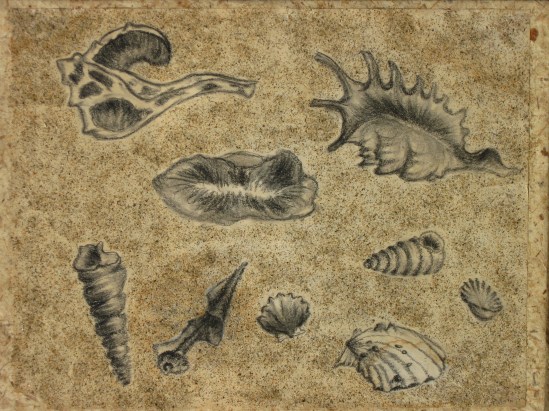
Shells (charcoal pencil)
And here’s the painting I now remember was actually the second one I did last year, after the pears. I was working from a murky Polaroid photo, and you can tell. It’s an obvious beginning exercise, but it was exciting to do a landscape for the first time and figure out the layers of background, middle, and foreground. I keep almost gessoing over this but I have a soft spot for it.

Azalea (oil on canvas board)
I visited my friend Liz in New York a couple weeks ago and did this quickie of her reading the paper at a coffee shop.

Liz (pencil)
And last Saturday I drew this tree in the Boston Public Garden.

Public Garden (pencil)
Now I want to try to catch up and show what I’ve been working on over the year. I started my oil-painting class last June, so let’s go sequentially from there.
The first assignment in class was a value painting, using only black, white, and one color. We had to copy from this one particular photo in a book. I chose burnt umber (but I think I used raw umber when I went back to finish it in the second class!).

Pears (oil on canvas board)
I think the nasturtiums must have been the second painting I did last year. I took this picture at some point of near completion and gave the painting to my mother before taking a finished photo. It’s just 5 x 7 inches. This one marks my fatal plunge into minute detail. The pears value study didn’t give me the chance because it was such a simple photo, but when I started working from my own photos, all was lost. I got into the habit of trying to copy every detail of my photos picture and I’ve been struggling against that ever since. You’ll see.

Nasturtiums (oil on canvas board)
Here’s my oldest drawing. It’s from a class in college, and the paper is stained and crumbling so I framed it behind glass, hence the reflections, sorry. That’s a nice big one, 18 by 24 inches I guess.

Garlic (charcoal on paper)
My workplace:
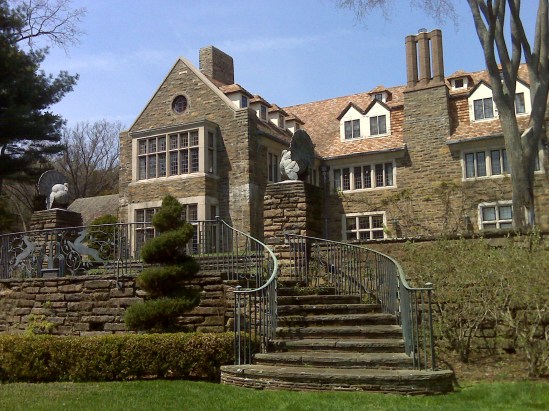
Manor House (BlackBerry camera)
For three years I’ve been working here in this old mansion in a small town on the North Shore of Massachusetts, and now the company is moving to Boston. In two weeks I start commuting on the train to a city office building and working at a desk without even cubicle partitions, instead of an office with this view:
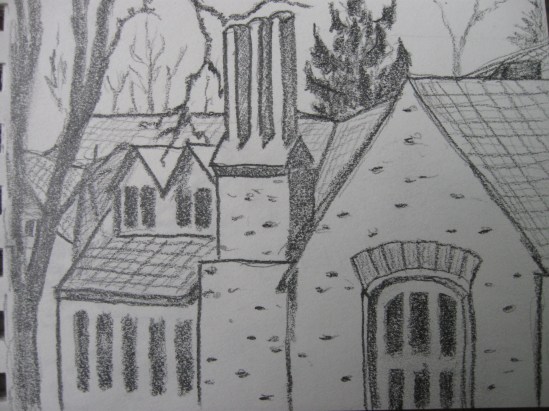
Office View (6B pencil)
This is the first drawing in the little sketchbook I bought a few months ago and have been too scared to use. When I started an oil-painting class last June, the teacher had us work from photographs and that’s all I’ve done ever since. Recently a painter acquaintance pointed out what a disservice this is to new students, because there’s so much more to learn by working from life. I’m not quite ready to paint from life, so I decided to start with sketching.
I happened upon a podcast, “An Illustrated Life,” by Danny Gregory, in which he interviews artists and illustrators about their sketchbooks. He’s just published a book of the same name that features these people’s work. (See http://dannygregory.libsyn.com.) I’ve been inspired by some of these interviews and I’m going to try using my sketchbook while working on my painting.

Harbor Lowtide (charcoal pencil)
The second sketch in my little book, low tide at the side of the harbor.
Drawing, sketching, painting every day
Arts and Philosophy, Zen Painting, Daoism & Calligraphy in Theory and Practice. A blog about Asian culture, art, and travel.
L'essenziale è invisibile e agli occhi e al cuore. Beccarlo è pura questione di culo
Artist
Je vois naître un nouveau monde. Je veux le connaître. Je veux le peindre.
Words and Pictures from the Middle East
Sharon Kitching Artist
Reflections on Canadian Culture From Below the Border
Rhymes and Reasons for Every Season
.. على ضفاف المدينة .
New Evidence of Past Civilizations
Your Brain is a Radio that Does What its Told
Traveller, photography
Paint draw travel and share
Painting, Drawing and Surface pattern designs
to be worth sharing
Before I forget
art and the intimate unknowable
Literary researcher
Every tree has a story
Sand and salt under my feet, moon over my head. I am an artist living in Florida. Works available at https://www.Society6.com/sandsaltmoon
"When no one is listening to you, just use your creativity to showcase it to the deaf world"
My photography and other stuff
Haiku, History tidbits, Canine Commentary & Uncomplicated Thoughts
bleib ruhig hier
painting & drawing
Creativity in my other life
revisiting sydney & sketching ... a journal
The fantastic world of fractal art and other stuff
My Creative Endeavors
images as thoughts
There are infinite possibilities in the creative process.
Paintings, doodles & other art by Marco Bigliazzi
I like putting makeup on my face.
Welcome to my online sketchbook
portraiture landscapes & figurative
a blog about my garden and my soft spot for cacti and succulents, travelling and art
OCA Illustration learning log
G’day, you’re at the best wine blog ever! We're all about wine; without the wankery.
Nature photography
This WordPress.com site is the cat’s pajamas
Art explorations by Toronto artist Anne Chun
 Art for Tiny Houses