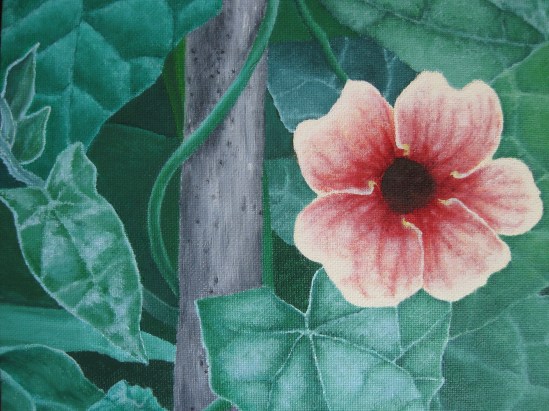
Black-Eyed Susan Vine (oil)
Black-Eyed Susan Vine (oil)

Rat (oil)
A skiff named Rat that lives in Rockport’s Inner Harbor, painted August ’08. Traded to Janine and Paul for a loveseat!

Dinghies (oil)
Dinghies in Rockport’s Inner Harbor. Painted for Susan and Jon, November ’08.

Annisquam (oil)
Harbor Wall in Annisquam, Gloucester, Mass. Painted in September ’08.
Goodbye to the mansion. For my last two weeks there I had this view and the smell of lilacs from my office window.

Office View with Lilac (pencil)
And here’s my new desk.

Van Gogh said:
At times there is something indescribable in those aspects — all nature seems to speak; . . . As for me, I cannot understand why everybody does not see it and feel it; nature or God does it for everyone who has eyes and ears and a heart to understand. For this reason I think a painter is happy because he is in harmony with nature as soon as he can express a little of what he sees. And that’s a great thing — one knows what one has to do, there is an abundance of subjects, and as Carlyle rightly says, “Blessed is he who has found his work.”
(From Van Gogh: A Self-Portrait, W. H. Auden, ed., 1963)
Here’s a little painting from a place near my favorite marsh, a meadow verging on marsh, last fall.
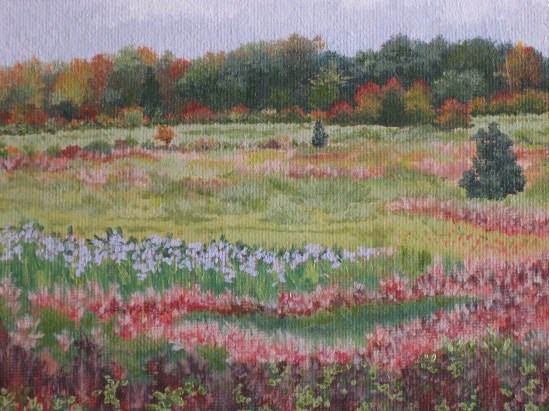
Essex Meadow, October (oil)
I’m reading the letters of Vincent Van Gogh (Van Gogh: A Self-Portrait, edited by W. H. Auden, 1963) and he has so many beautiful and encouraging things to say about art, including literature. Here’s a quote I love from a letter to his brother Theo in June of 1879:
I still can find no better definition of the word art than this . . . ‘art is man added to nature’ — nature, reality, truth, but with a significance, a conception, a character, which the artist brings out in it, and to which he gives expression . . . which he disentangles, sets free and interprets. A picture by Mauve or Maris or Israels says more, and says it more clearly, than nature herself.
I love this because I’ve always thought that, as beautiful, powerful, and ingenious as nature is, it’s almost equaled by humanity. Yeah, I know, people seem to do nothing but destroy this world and each other. We’re powerful and ingenious too, to bad ends. But on the other hand, we too have produced works of beauty and ingenuity for eons. And we’re the only animals who are capable of all this love and rapture over nature, all this striving to understand and “give expression to” nature and our fellow humans. Without us, who would appreciate the wonders of nature?
I’ve only been getting really familiar with Van Gogh’s work for the last ten years or so, but I must have known enough of him to have unconsciously emulated him when I drew this tree in the Chelsea Physic Garden in London, way back in 1990.

Chelsea Physic Garden (pencil)
On the other hand, this painting was an outright copy I did for practice last year. It definitely was good practice for fighting the urge to do too much detail.

After Van Gogh (oil on canvas board)
I also love doing freeform crochet.

Freeform Crochet Bag (wool and mohair)
Here’s another of my oldest drawings, just some practicing with shells. The paper was old and stained, so I made a collage out of it by mounting it over handmade paper and gluing sand all around the shells.
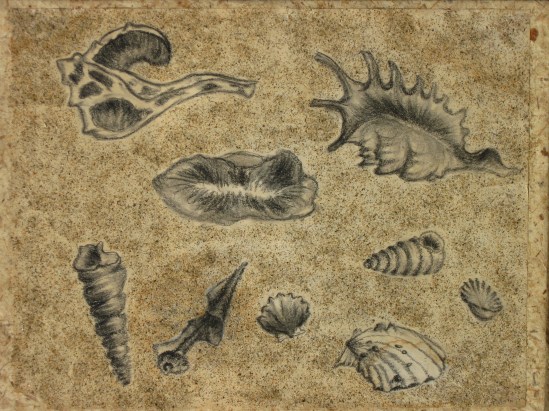
Shells (charcoal pencil)
And here’s the painting I now remember was actually the second one I did last year, after the pears. I was working from a murky Polaroid photo, and you can tell. It’s an obvious beginning exercise, but it was exciting to do a landscape for the first time and figure out the layers of background, middle, and foreground. I keep almost gessoing over this but I have a soft spot for it.

Azalea (oil on canvas board)
Drawing, sketching, painting every day
Arts and Philosophy, Zen Painting, Daoism & Calligraphy in Theory and Practice. A blog about Asian culture, art, and travel.
L'essenziale è invisibile e agli occhi e al cuore. Beccarlo è pura questione di culo
Artist
Je vois naître un nouveau monde. Je veux le connaître. Je veux le peindre.
Words and Pictures from the Middle East
Sharon Kitching Artist
Reflections on Canadian Culture From Below the Border
Rhymes and Reasons for Every Season
.. على ضفاف المدينة .
New Evidence of Past Civilizations
Your Brain is a Radio that Does What its Told
Traveller, photography
Paint draw travel and share
Painting, Drawing and Surface pattern designs
to be worth sharing
Before I forget
art and the intimate unknowable
Literary researcher
Every tree has a story
Sand and salt under my feet, moon over my head. I am an artist living in Florida. Works available at https://www.Society6.com/sandsaltmoon
"When no one is listening to you, just use your creativity to showcase it to the deaf world"
My photography and other stuff
Haiku, History tidbits, Canine Commentary & Uncomplicated Thoughts
bleib ruhig hier
painting & drawing
Creativity in my other life
revisiting sydney & sketching ... a journal
The fantastic world of fractal art and other stuff
My Creative Endeavors
images as thoughts
There are infinite possibilities in the creative process.
Paintings, doodles & other art by Marco Bigliazzi
I like putting makeup on my face.
Welcome to my online sketchbook
portraiture landscapes & figurative
a blog about my garden and my soft spot for cacti and succulents, travelling and art
OCA Illustration learning log
G’day, you’re at the best wine blog ever! We're all about wine; without the wankery.
Nature photography
This WordPress.com site is the cat’s pajamas
Art explorations by Toronto artist Anne Chun
 Art for Tiny Houses